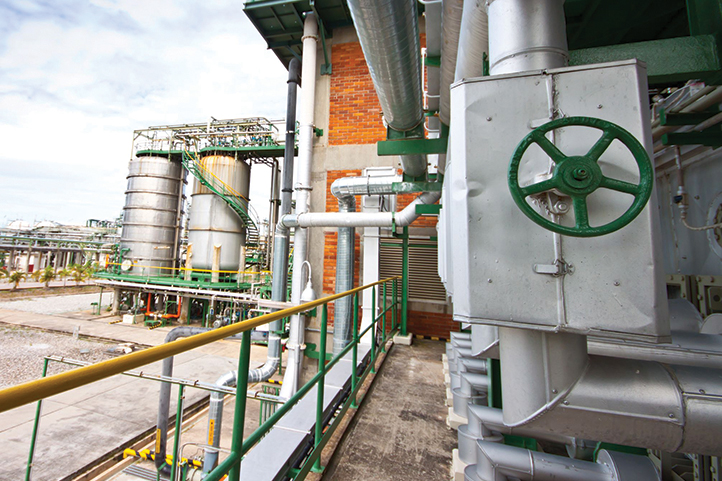
A former Nekoosa Packaging Corporation in Valdosta, Georgia, USA, needed to eliminate hammering and scaling problems exhibited by existing green liquor heater. Nekoosa has been using an externally modulated direct contact steam heater, mass steam flow rate was controlled by varying the pressure of the steam with an external control valve. The resulting pressure variations of the steam resulted in a reduced range of stable operation. When the heater was operating outside the limited range of stability, the heater exhibited severe hammering and vibration with consequent damage to internal components.
Fluid: Green Liquor
Flow Rates: 300-800 GPM [82-218 m³/hr]
Inlet Temperature: 140°F [60°C]
Discharge Temperature: 190°F [88°C]
Fluid Supply Pressure: 40 PSIG [3 barg]
Steam Supply Pressure: 150 PSIG [10 barg]
SOLUTION
Hydro-Thermal engineers installed the K414AN Hydroheater prior to the slaker in order to precisely control temperature and maximize the conversion efficiency of slaked lime. Installed in 1989, the mill reported that all hammering and vibration had been eliminated. The temperature of the green liquor had been precisely maintained at 190˚F [87.8˚C], and the Hydroheater has operated without scaling or fouling.
Update: Regular maintenance can provide years of service even in a corrosive environment. The mill carries a spare heater for easy swapout and uses a 2-3 year rebuild schedule to replace internal wear components. The current heater is on the fourth rebuild and has been in operation for 12 years.
This major tire and rubber company needed to heat 26% PVC slurry without hammering and plugging. The slurry required heat added prior to dewatering in a centrifuge. Indirect methods of heating were not considered because of the high potential for the slurry to foul the barrier heat transfer surface. For this reason, a competitive direct-contact steam heater was being used; however, the heater hammered violently, compromising pipe fittings and supports. Periodically, the PVC slurry would back-flow into the steam supply line and harden, requiring disassembly for acid bathing.
Fluid: 26% PVC Slurry
Flow Rate: 45 GPM [10 m³/hr]
Inlet Temperature: Variable; 35-120°F [2-49°C]
Discharge Temperature: 167°F [75°C]
Steam Supply Pressure: 60 PSIG [4 barg]
SOLUTION
The Hydroheater was evaluated for this application because of its ability to handle viscous slurries with high solids. Internal modulation of steam in the Hydroheater would eliminate the hammering problems and the potential for the PVC slurry to backflow into the steam lines.
Hydroheaters were installed and have been operating since 1987. The hammering problems associated with the competitive heater have been eliminated. Internal modulation of steam in the Hydroheater prevents the slurry from back-flowing into the steam supply lines. The need for routine cleaning has been eliminated due to its self-cleaning design.
GOAL
• Eliminate hammer and plugging • Eliminate back-flow into steam supply line • Eliminate acid bathing
A carpet manufacturing facility wanted to replace the current heat exchanger with a better water heating solution for their wash box station. They were looking for: energy efficiency, better temperature control, and better turndown control and capabilities.
Flow Rate: 200 GPM [55 m³/hr]
Inlet Temperature: 50˚F [10˚C]
Discharge Temperature: 110˚F [43˚C]
Water Supply Pressure: 85 psig [5.9 barg]
Steam Supply Pressure: 100 psig [6.9 barg]
SOLUTION
Hydro-Thermal’s EZ Heater® model H2030 with a Large (L) diffuser was installed to successfully adhere to each of the specifications desired. The customer has realized the inherent advantages of its design with:
• Easy installation and replacement of technologies • 28% more efficient than the heat exchanger • Instantaneous hot water on demand at exact temperature • Excellent turndown control and capabilities • Patented self-cleaning design to prevent scaling and fouling
GOAL
• Increase efficiency • Precise temperature control • Improve turndown control and capabilities
ACCOMPLISHMENTS
• 28% more efficient • Instantaneous exact temperature control • Lower maintenance • Excellent turndown
Are you wondering what applications are ideal for direct steam injection? Visit our industries page to learn more about industries and applications.